After the recent fandom explosion over the SAG-AFTRA (SAG) video game strike, I and some fellow lore nerds embarked on a deep-dive into the intricacies of unions, the National Labor Relations Act (NLRA) which legalizes unionization in the US, and how it applies to the voice acting (VA) industry.
We spoke directly to SAG representatives (although we weren't able to speak to SAG Interactive, which is behind the strike) and industry insiders (ones who aren't VAs and don't have any stake on SAG issues), and we also perused hundreds of articles and websites to expand our knowledge about the issue. However, like everyone else who's posted on the issue, we are not lawyers specializing in union contracts. This post is a simplified overview of the situation based on a wide array of sources; the NLRA is deliberately vague, and specific applications need to be decided in court.
The post will cover the following subjects:
- How unions work in the US (plus Taft-Hartleys [TH] and Financial Core [FiCore])
- Why entertainment guilds like SAG aren't like most other trade unions
- How the VA industry works and what it means for the SAG strike
- How all the above applies to Genshin's history with unionization
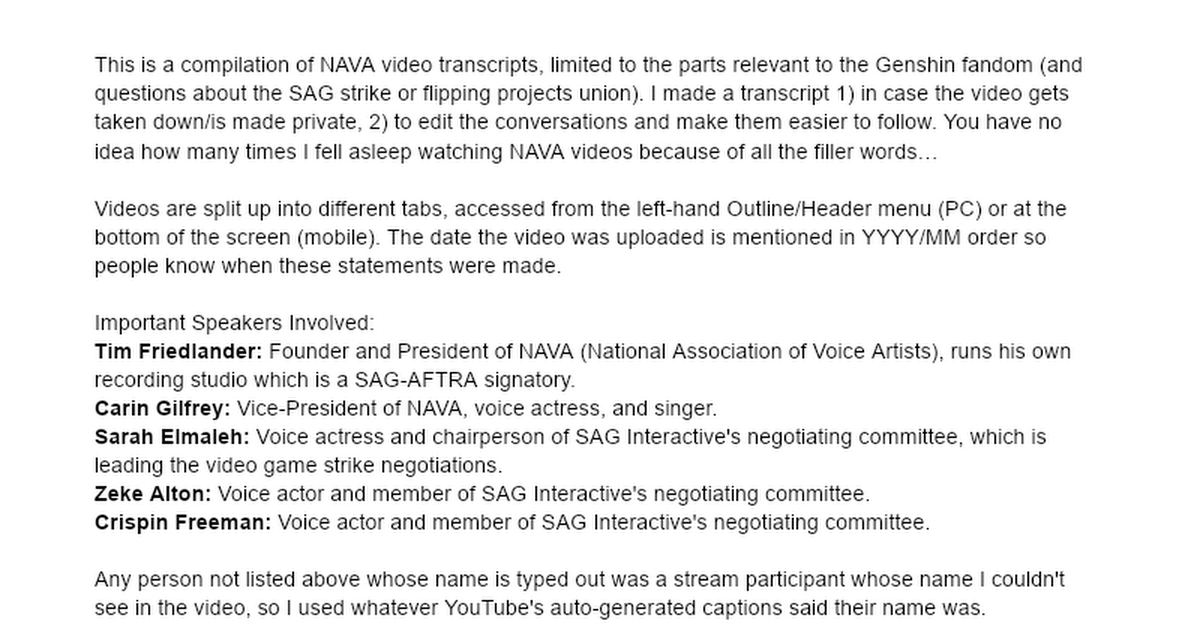
Important terms are bolded, and anything with [Note] has a footnote included at the end of the section. We've also made a transcript of relevant videos from NAVA (the National Association of Voice Artists) which we'll reference throughout.
Hopefully people come out of this with a better understanding of the complexities of the industry and the laws. This post probably won't change anyone's minds, but maybe it'll lead to some more productive conversations. While the post leans SAG-critical, that's because it's easier to find dirt on SAG and VAs. Formosa and Hoyo aren't saints either, they're just better at keeping their inner politics out of public view.
Unions in the US
Explaining SAG's actions and the terms on their collective bargaining agreements (CBA) requires starting with federal law due to how big a role it plays.
Unions are organizations made to help employees receive fair compensation and protection from their employers. Since employers have power over workers' livelihoods, unions balance the scales with collective bargaining, AKA the power of the masses. Uniting under a single banner allows unionized employees to legally fight back if employers try to take advantage of them. In exchange, unions take out a small bit of workers' paychecks as union dues to employ staff, promote their causes, fund member benefits, and lobby Congress (get politicians to back their cause; SAG's support for the NO FAKES Act, which would establish protections from unauthorized generative AI on a national level, is an example of lobbying).
The National Labor Relations Act (NLRA) of 1935 legalized unionization and has been amended by the US government through later Acts and legal proceedings, such as the Taft-Hartley Act and the added definition of "financial core." [Note 1]
Normally, unionization occurs when employees at a workplace [Note 2] want to be protected by a union. If enough people agree, they can submit a request to the National Labor Relations Board (NLRB), which will then make sure employers form a CBA, also known as a union security agreement, with the applicable union. (Employers can also voluntarily sign a CBA without the NLRB's intervention.) As with all legal documents, the parties who sign a contract are known as signatories.
(Note 1: Currently, many union supporters in the US are on edge about anti-union rhetoric after Trump attempted to purge the NLRB of union supporters when he took office in January. This caused people otherwise uninvolved in Hoyo fandoms to come out of the woodwork to defend SAG, flaws and all.)
(Note 2: Many unions are massive organizations separated into Locals based on geographical region and/or categories of work ("trades"). A CBA's scope is usually determined on a per-location, per-trade basis: A supermarket chain could have unionized retail associates in one store while they're non-union in the next town over; additionally, management is usually required to be non-union regardless of the store's union status. A movie set may have contracts with multiple unions at once for all the different involved trades.)
How Strikes Work
Most CBAs last for a few years and are renegotiated between the employer's and the union's bargaining teams (AKA negotiating committee). Employers refusing to agree to terms the union deems critical (like giving actors AI protections) are usually why a strike happens — a term for when employees refuse to work, crippling normal operations and forcing employers back to the negotiating table.
Normally, strikers hold picket lines outside their workplaces to bring attention to their cause. "Crossing the picket line" means working for a struck company, while "scab" is a derogatory term for someone who does that work. In most unions, part of a person's dues are put into a strike fund, which is paid out to striking employees based on how much they put into it. Sometimes, strike funds are even used to pay off would-be strikebreakers.
Under the NLRA, workers participating in a lawful strike [Note 3] must be allowed back to their jobs after the strike ends. This comes with a big disclaimer: The NLRA only applies to "employees." Independent contractors are not covered by the NLRA and don't have the same legal protections as employees. (Notably, calling SAG's moves "monopolization" is exactly what US laws would otherwise say; see "Unions for Independent Contractors" for a detailed explanation.)
(Note 3: Wildcat strikes are unlawful strikes conducted by union members without authorization from their union's leadership, while solidarity strikes/secondary boycotts are unlawful strikes in which workers not covered by a particular CBA go on strike to show support for the legally striking workers, or when legally striking workers affect work at a "neutral" party. In both instances, employers have the legal right to replace the unlawfully striking workers.)
The Taft-Hartley Act
The Taft-Hartley Act did a lot to curb the power of unions, but the 3 most pertinent parts in this situation are:
1. States were given the right to establish "right-to-work" (RTW) laws which make it illegal to require paying union dues or make union membership mandatory. Because unions are still obligated to use their resources to help those who don't pay (full) dues, such people are derogatorily called "free riders." (27/50 US states, including Texas [a major hub for anime dubbing] are RTW states; the rest, including California [where most video game dubbing is done], are not. "Guilds and Unions in Right-to-Work States" explains how Texas' RTW laws interact with entertainment guild rules, specifically in the screen acting industry, which SAG's system was designed for.)
2. It allowed "union shop" agreements (where employees must become union members and start paying dues after being hired) on the condition that NU hires are given a minimum 30-day "free trial" with the union before having to decide whether to stay at the job and start paying into the union, or leave. (In "regular" unionized workplaces, the employer will automatically start collecting dues on the employee's paycheck after the 30 days are up.) When people talk about a "Taft-Hartley" or getting "Taft-Hartleyed" (TH), they're referring to this.
3. It excluded categories of workers like independent contractors from the NLRA's protections. (This paper about the difficulty of securing music video dancers' legal rights breaks down the employee vs. independent contractor situation.)
Financial Core (FiCore)
FiCore was created after a worker refused to pay dues to a union that financially supported a politician he disagreed with. The Supreme Court determined that unions have the right to collect some dues to do their work, since it benefits all workers signed to their CBA, including ones who don't want to be members or like the results of that bargaining.
Employees who don't want to be associated with the union were instead given the right to renounce their union membership, become a "fees-paying non-member," and pay only what is needed to sustain the union's "financial core" responsibilities, like collective bargaining and providing health insurance and pension plans. With a later ruling, non-members could also reduce their fees by opting out of the amount used for union organizing and lobbying.
SAG-AFTRA and the VA Industry
SAG-AFTRA is an entertainment union which covers performers in a wide array of media. It formed after the Screen Actors' Guild (SAG) and the American Federation of Television and Radio Artists (AFTRA) merged in 2012, which was a saga in its own right.
Like most entertainment unions, SAG faces two main problems: The different classifications of union (employee) and non-union (independent contractor) workers, and how to maintain funding when their members don't have a consistent paycheck to collect dues from.
To determine whether a worker is an employee or contractor, the NLRB has a list of criteria to compare against (although they work off past cases' decisions, not an actual list). SAG games this system by adding enough provisions to their CBAs to make their performers considered employees and thus protected by the NLRA.
For example, their CBAs have employers pay into SAG's benefits (like health insurance and pension plans) to make performers' employee-ness as rock-solid as possible. Naturally, it helps performers as well (and health insurance coverage was given as a major reason why Corina Boettger and Marin Miller wanted Genshin and Hades II, respectively, to get unionized), but the provision is there to help make SAG's members legally considered employees instead of independent contractors.
The issue of irregular work puts entertainment unions at a disadvantage compared to "regular" unions. In the past, entertainment guilds lowered their expenses by limiting membership to those who proved their skills in the industry and could consistently book roles, with high initiation fees being part of that membership filter — SAG's hefty initiation fee ($3000 until March 2025; now it's $3060) [Note 4] is a holdover from those days. Industry members largely knew that joining these guilds was meant for those who could make a living exclusively on union work. But times have changed.
(Note 4: While SAG's credit union gives loans to those who can't pay the initiation fee upfront, players started mocking it with phrases like "imagine needing to take out a loan to get a job" and "they're the SAG-MAFIA." Funnily, mafia meddling helped SAG's rise in the industry in the 1930s. When the mafiosi controlling Hollywood's unions tried forcing SAG to fall in line, SAG's president instead led the investigation which exposed and ousted them. Also, the Hollywood mafia didn't need to assault scabs — they worked with studios to forcibly end actor strikes without giving them any concessions.)
Today's Landscape
External factors like economic fluctuations and successful attempts to weaken unions nationwide — combined with SAG's underestimation of technology's effect on the entertainment industry (refusing to engage with freelancing sites like Voices.com led them to be 13 years late to the party, only partnering with them starting in 2018) — led to where we are today: About 80% of available voice-over (VO) work is now NU. This doesn't seem to mesh well with SAG's Global Rule One (GR1): If a SAG CBA exists in a particular jurisdiction, members don't work for any employer that isn't signed to a SAG CBA. [Note 5]
Likely as a result of this, out of the 1,305 respondents to NAVA's 2025 industry survey, 65% of VAs are NU, 19% are SAG members, 12% are FiCore, and 4% responded with Other. Of the SAG members, 57% admitted to working on NU projects (breaking GR1, or working "off-the-card") at some point. Notably, one common write-in reason for breaking GR1 was summarized as: "It was early in my career, and I didn't know any better."
With the internet opening more avenues for talent to be discovered, the industry has now expanded to include many performers without a traditional acting background (think popular VAs who started by being YouTube-famous) and who thus are much less likely to have been familiar with the ins and outs of entertainment unions before joining SAG. When combined with the predominantly NU landscape of the VA industry, it's no wonder that SAG ended up with plenty of members who would easily run afoul of GR1.
And that’s not all: Even those who would, in fact, "know better" are still working off-the-card. In fact, nearly two thirds of the NAVA survey respondents who admitted to working off-the-card are doing so at least several times per year. The top two reasons (for working off-the-card at any point), picked at similar rates and outpacing all others:
- There are more NU work opportunities.
- They can't make enough money on union work alone.
Unsurprisingly, contending with both high-profile VAs and screen actors (such as in multimedia IPs where VO roles often go to their corresponding screen actors) for what little VO union work exists has led many VAs to feel they need to either work off the card or go FiCore, especially when the industry is not known for paying well (which many blame on the generally low-paying NU market) while also being primarily located in areas with high costs of living. It doesn't help that SAG's leadership has proved divided in their response to efforts like a reform attempt in 2020 made by the rank-and-file SAG members who know what the VO landscape now looks like… and so this frustrating status quo has remained unchanged.
Said status quo includes the promotion of what SAG has long seen as an obvious solution to the whole issue: Turn NU projects into union ones. In entertainment unions, this is a process known as "flipping," and as a result, there are many companies that provide third-party signatory services, signing SAG CBAs themselves to serve as middlemen between SAG and producers.
(Note 5: "Jurisdiction" goes back to how a union can only act in a workplace signed to its CBA. According to Question 2 of NAVA's YES U CAN video, work for employers who are not SAG signatories is technically non-jurisdictional and doesn't violate GR1. The difference between a national TV station with a SAG CBA vs. a local cable channel without one was used to illustrate the difference. In practice, non-jurisdictional and NU are considered synonymous.)
The Flipping Problem
Some VAs like Keith Silverstein (Zhongli) have mentioned that their "SAG stories" involve working on a NU project that was flipped with the arrival of a high-profile union actor, forcing all the NU VAs already hired to choose between joining SAG or leaving their roles. [Note 6] Since THs are limited, NU VAs in flipped productions who want to keep the work they thought they had secured may end up pushed into SAG before they're ready.
Additionally, while some producers have no problems eating the extra costs incurred by flipping if it means supporting the talents making their work possible [Note 7], most video games have a fixed budget which determines how much they will spend on VAs. Casting directors will tell VA agents to find someone willing to take whatever rate they give; negotiations are reserved for the famous ones.
(Note 6: SAG considers any solo speaking role, regardless of length or prominence, as a Principal role, which means a NU VA becomes SAG-Eligible (SAG-E) after getting TH'd onto 1 SAG role. Legally, SAG is actually allowed to require membership after the 30-day TH period ends, but NAVA's website mentions an "OK 30" rule that allows NU VAs a 2nd SAG role before they become a "must-join." It's not mentioned on SAG's website, so it likely compensates for VAs' short recording sessions — a typical SAG VA session can only go up to 4 hours.)
(Note 7: According to NAVA's YES U CAN video, in order for SAG's minimum pay scale of $505 to actually end up as a VA's take home pay for 1 hour of work (assuming the VA lives in Los Angeles), the employer must pay about $745~$840 — the extra cost covers things like health insurance, pension plans, and California-mandatory worker's compensation benefits.)
The FiCore Problem
Going FiCore to get more work in the entertainment industry is a two-part loophole:
- A non-member isn't subject to union rules, so they don't need to follow strike orders or (in SAG's case) avoid NU work.
- Paying fees to SAG legally fulfills the requirements of the CBA, so they can't be excluded from a union project, either.
Because going FiCore was made for workers who don't want to be associated with the union or have their money go towards the union's cause, many union members consider it an affirmation to employers that there will always be people in the industry who will do whatever it takes to get their next paycheck.
SAG's annual report to the Department of Labor reveals that as of July 2024, out of 268,926 members + fee-payers (FiCore non-members), 177,347 (65.95%) are active members, 86,428 (32.14%) are inactive members, and 5111 (1.90%) are FiCore.
While 1.9% might seem like a tiny number, it is actually one of the largest percentages among all unions, as pointed out in the comments of one Deadline article from 2022 (and verified with various unions' 2024 annual reports). For example, 0.3% of members in the AEA (Actors' Equity Association) are FiCore, while in a "regular" union like UFCW Local 1 (representing food and grocery workers in New York State) an even tinier 0.08% are FiCore.
SAG's Financial Core page is probably at least partially to blame, as it fails to explain the origins of financial core and its hilariously aggressive rhetoric has caused many to turn to the internet for advice instead. (To drive the point home, have a look at the AEA's equivalent article.)
What If Genshin Flipped?
The process of becoming a union project can be confusing, even for projects that are fully on board with it, and even with SAG's efforts to make the process smooth and easy. We gathered answers for common fandom talking points from NAVA's community classes, SAG representatives, and websites related to labor law.
How would going union affect non-US VAs?
It wouldn't affect them at all. A SAG Contracts representative told us SAG CBAs for foreign productions simply allow them to hire SAG actors and do not restrict their ability to hire US NU actors or any local/otherwise non-US actors. (It gets a bit tricky when dual citizenship with the US is involved, but that's probably not applicable to any VA in Genshin's other 3 VO languages.)
The "Joining fees for performers living outside of the country" FAQ on SAG's website is meant for US performers who continue entertainment work after moving abroad, and foreign actors who purposely come to the US to work on SAG productions.
How would it affect VAs who voiced characters in past versions?
Becoming a union project requires making new contracts, so all CBA terms only affect the project going forward. VAs would not get TH'd for work that was already completed, but any NU VA who wants to continue working on Genshin (which especially affects playable characters' VAs) would need a TH, with all its accompanying rules. (See YES U CAN Question 18.)
(While TH approval isn't guaranteed, I'd imagine that if Genshin became a SAG signatory, either through Hoyo or a third-party signatory, they'd redline [a term for changing parts of a proposed contract which one side finds disagreeable] the TH section and argue that all returning NU VAs be guaranteed a TH. If they're particularly forceful, they could fight for a complete waiver, but SAG doesn't hand those out easily.)
If a VA chose not to return because Genshin became a SAG signatory, Genshin's precedent for recasting VAs for non-scandal-related reasons (see CN Amber) suggests their previous recordings would be replaced by a new VA nonetheless.
How hard would changing the contracts be?
It's probably harder to pull off than typical US video game VA contracts, which are daily contracts signed on a literal per-day basis and not on any long-term scale. Those contracts let a producer change its terms the next time the VA, referred to as a day player, comes around (if ever). (The description Corey Landis [HSR's Welt] gave about his employment with HSR is similar to a day player's.)
An industry insider who wished not to be identified here told us that Hoyo doesn't do that for Genshin; they sign VAs on for a certain period of time without saying who they'll voice or when they'll return. After that, they're completely uninvolved with the dubbing process. While some VAs allegedly have direct contact with Hoyo, most of them have to go to their agent, who goes to the casting director, who then passes the message to Hoyo.
Why does it have to be Hoyo that signs a SAG CBA, anyway?
There's a loophole that third-party signatories use to hire NU VAs. Normally (in theatrical or film productions, which is SAG's main focus) the CBA's "producer" (the employer) would be whoever works directly with the actors. The SAG Voice-Over representative told us that it is very unusual for game developers themselves to be signatories; our industry insider said devs may be the producers in union games, but it depends on the contract terms.
However, in the VA industry and especially the dubbing scene, publishers (like Hoyo) are the ones doing the hiring and, therefore, the ones deciding whether to sign a SAG CBA or not — even if they're barely involved in the recording process. If the publisher doesn't make the project union, the CBA signed by a SAG signatory studio (like Formosa) is irrelevant, and they can call on NU VAs for the production. If the publisher makes the project union, then the studio will abide by the CBA's terms. (Riot Games' response when SAG struck League of Legends affirms this. This AMA with a Bayonetta casting director, while unrelated to the strike, can be a useful point of reference as well.)
The SAG Video Game Strike
As mentioned earlier, VAs are typically day players for video games in the US; a VA can be replaced at any time, and the producer doesn't need to tell them. (And it's not just video games: Carolyn Lawrence, the VA of Spongebob Squarepants' Sandy, explains her experience as a day player on the show in this TikTok interview.)
This industry culture makes generative AI (genAI) a big issue for US VAs and motion capture (mocap) professionals. In an industry where there is little job security to begin with, now companies might replace them with a synthesized version of their voices, faces, and bodies, trained on files of their past work, all without getting their permission or giving them compensation.
When SAG and the 11 major studios they're negotiating with were renegotiating the IMA (short for Interactive Media Agreements), the SAG Interactive CBAs which most large studios are signatories of, AI was where negotiations broke down. (Formosa Interactive is one of those 11 studios.) The stalemate continued, which led to a vote in 2023 where SAG members authorized a strike if those corporations continued to refuse limitations on genAI.
TL;DR: The SAG strike really is about AI. NAVA and SAG Interactive's negotiating committee have been trying to educate the public and unite the different VA industry factions. During Interactive Town Hall #2, held a week before the Version 5.5 drama began, NAVA emphasized educating the public at every opportunity, saying that "the goal is not to shut people down" when VAs take NU work, as there are many who don't know about the strike. (Takanashi and Landis' statements regarding the strike reflect that.)
Unfortunately for the strike's leaders, SAG itself is the worst PR they could ask for, while faction politics, personal motivations, and a general lack of clarity regarding the strike have led to many different interpretations of SAG's Strike Notice to Members. So we went digging for more answers!
How does the strike even work?
Any project that is signed to one of the three IMA, but which isn't covered by the Side Letter 6 provision or hasn't signed one of the Interim IMA (I-IMA) that includes AI protections, is struck. Any studio which has signed the IMA is also struck, but because the project's status takes priority, VAs are allowed to cross the picket line to work on legally covered work (whether it's on an I-IMA, a Side Letter 6 provision, or non-jurisdictional).
The 11 major studios on the other side of the table are a "convenience bargaining group" — they conveniently share the same lawyer firm: Kauff, McGuire & Margolis, LLP (KM&M). [Note 8] By negotiating with these big-name studios, which comprise the majority of the US video game industry, SAG hopes to set the baseline for all other studios. However, these 11 studios aren't working together, so if only one or two of them don't agree to SAG's terms, negotiations come to a standstill.
So are Hoyo games struck or not?
Officially, no. Work for an employer who is not a SAG signatory is non-jurisdictional, and SAG members can't face disciplinary action for working for them. (The gaming news site Game Developer, which has an amicable relationship with SAG, has also stated that Genshin and ZZZ aren't struck.)
Due to its affiliation with SAG signatories Formosa Interactive and, now, SIDE Global, union VAs can voluntarily strike Genshin and their jobs will be protected, according to SAG's Strike Notice [Note 9]. However, for part of 2023 and most of 2024, Genshin recorded at Formosa Interactive's non-signatory side, Formosa Ocean Post (FOP), which complicates matters.
HSR and ZZZ, which are produced by the (AFAIK) non-signatory Rocket Sound and Sound Cadence, are outside the strike's scope. VAs striking them to show their resolve over AI protections do so at risk of their jobs.
As always, though, everything above is based on what our independent findings have yielded, reinforced by statements from SAG-positive but otherwise outsider parties. SAG may have said otherwise in private, and they're obviously not going to publicly say that the easiest way to get VAs to work is to never get involved with SAG to begin with.
Erika Harlacher (Venti) said that SAG sent VAs threatening letters — what's up with that?
Whether it's members with pent-up resentment towards VAs who work off-the-card or went FiCore, or those with a desire to flip NU/non-jurisdictional projects so union VAs have more work and can pay towards benefits, the Strike Notice gave people motivation to report anyone working on projects without a CBA to SAG's disciplinary committee.
Members technically can't be disciplined for working on any Hoyo game during the strike, but reports to SAG's Disciplinary Committee may include prior instances of GR1 violations. As for FiCore VAs, SAG can permanently ban them from reinstating their membership if they try to later.
The VA industry's factionism and pervasive lack of communication is working against them here. If more VAs come out and suggest that SAG members have been pressuring them into not working, or that SAG is retaliating against them for participating in non-jurisdictional work, someone could probably level SAG with an unfair labor practices charge if they wanted to take the matter to court.
If SAG is really trying to protect actors, why did they make deals with AI voice-over companies? Why not ban all genAI?
As they've already learned, trying to completely block or disregard new and emerging tech is a fantastic way to lose their influence (see: Voices.com). Now that genAI exists and is already in use, it's essentially impossible to ban it entirely, especially when the other side has way more money to lobby Congress in their favor. (Disney alone could probably fight them and win.) The best they can do is establish a way to use it fairly and with VAs' consent as a baseline for what should and shouldn't be legal.
Wouldn't signing a SAG CBA violate Chinese laws? And doesn't China have AI protections anyways?
For the first question, the answer is no. Infinity Nikki, which is in the same position as Genshin (Chinese game being distributed globally through their Singaporean branch), is a SAG signatory according to SAG's signatory checker. People seem to be misinterpreting laws stating that all Chinese unions must be a member of the ACFTU.
As for China's AI laws, the current national regulations don't apply to any company (whether domestic or foreign) that only works with genAI for R&D, or use genAI to create content for their programs but don't give users the ability to use genAI themselves. In short, they probably wouldn't apply to Hoyo or any company which renders their services to Hoyo, and even if they did, these companies can easily find a loophole. (See an alternate interpretation of the law for good measure.)
(Note 8: KM&M came to fight — they partnered with a Californian lawyer specializing in union contracts to prepare for strike negotiations. The firm also has a history of unionbusting and is currently defending the American Civil Liberties Union after it was brought before the NLRB for… firing an employee who attempted to unionize its workplace. Yes, really.)
(Note 9: SAG's Strike Notice says that performers who strike a non-struck game produced by a struck company [ex. Genshin under Formosa Interactive] are protected and cannot be fired for that decision. SAG is likely interpreting the NLRA's Section 8(b) in such a way that projects in this category are "allies," which can legally be struck because of how closely related they are to the struck company. Section 8(b) is a notoriously ambiguous section to interpret; it could be argued that Hoyo is a "neutral," not an ally, thus making striking against Hoyo precarious.)
Genshin's History with SAG
Genshin already has a storied history with SAG. It started (as far as we know) with the unpaid VA fiasco in July 2023, which came to light through Corina Boettger and Brandon Winckler; it ended with Boettger apparently getting moved to a different studio (which they said was "non-struck" after the strike began), while Winckler refused to work with Genshin or Formosa Interactive again, saying Genshin needed to get unionized. The scandal is covered in Games Radar's article, so we won't rehash it here.
A month later, in August 2023, SAG cold-called Hoyo on Twitter and was ignored (there was no private response, either). This may relate to the little-known Genshin unionization attempt.
In April 2024, one attendee of NAVA's YES U CAN class called out Genshin (see Question 3), noting that hundreds of VAs work on such a big-name but NU job, and asked if there was a way to flip it without putting actors' jobs at risk. As it turns out, VAs already tried — and failed. To quote what SAG Interactive's negotiating committee chairperson, Sarah Elmaleh, shared about what she knew (text edited for clarity):
I know that in the case of Genshin specifically, there was a small group of actors who were working really hard to organize it and in this case, their third party signatory — their solution — was acting as a buffer, as interference, between them and the producer. The game's developer discouraged them from going union and I think that third party signatory wound up losing the job over it, but the project still isn't union, so yeah.
(Elmaleh used Genshin as an example of how not all signatories — in this case, most likely Formosa Interactive — work in the VAs' interest. [Note 10])
Corroborating the part about the third party signatory "losing the job" is the implication that Formosa Interactive stopped working on Genshin in 2023: While Genshin was included in Formosa Interactive's Highlight reels for 2021 (0:42) and 2023 (0:33), which cover their work in 2020 and 2022, it doesn't appear in the 2024 or 2025 reels for their 2023-2024 work. (There was no 2022 reel.)
But rather than ditching Formosa, Hoyo instead turned to FOP, a recording studio so closely tied to Formosa Interactive that SAG is taking the two Formosas to court for it. Continuing to work with the guys who stiffed their VAs (and moving to their non-signatory side, in particular) is a weird move, which is why Formosa's ties to the pro-business KM&M give us pause. While SAG CBAs probably wouldn't jive with Hoyo anyways, Hoyo is unlikely to know much about US union law. During the 2023 unionization attempt, they probably consulted Formosa Interactive (remember, they are a SAG signatory), and if Formosa skews pro-business, then that's going to inform Hoyo's response.
It wasn't until Version 5.2 and the subsequent announcement in January 2025, after the strike began, that Hoyo cut ties with Formosa completely and moved to SIDE Global. Once again, we have no idea what Hoyo's rationale was, but our insider told us that SIDE has not attempted to change the old contracts to include AI protections. Whether that remains true in the future has yet to be seen.
(Note 10: Our insider said Elmaleh's statement about the signatory running interference between the unionizing actors and the producer made no sense, because the signatory and the producer would have been one and the same. Considering how little is known about this event, it's hard to tell if Elmaleh received bad information, misinterpreted, or misspoke.)
Conclusion
We could make an entire second post picking apart Formosa Interactive's shadiness (and KM&M released the 11 studios' "final proposal" yesterday with disingenuous rhetoric — SAG's response is entirely justified), SAG's policies, and the Genshin EN VA community's conduct (we chopped 15k+ characters to squeeze this post into Reddit's post limit), but let's end with this:
Players have largely agreed with giving VAs AI protections and were supportive of the strike, even explaining the situation to others for 8 months since the strike began. But complacency with the strike's popular support led VAs to carry on like usual instead of doing everything they could to further educate the community (a large portion of which isn't from the US and knows nothing about its union politics), so when VAs used the strike to rationalize suddenly being rude en masse on the internet, people turned to SAG for answers. Considering all it took to turn people against SAG was a reason to look at their website, SAG only has itself to blame — not some hypothetical unionbusting fandom infiltrator.
NAVA and SAG Interactive might not be perfect (we got ghosted after getting a preliminary response), but they're genuinely passionate about educating… other VAs. (Their resources may be public, but we only discovered them after one VA mentioned them offhandedly.) The greatest danger to a union is a lack of education — and hopefully people have learned that now.
View Reddit by LHFF – View Source